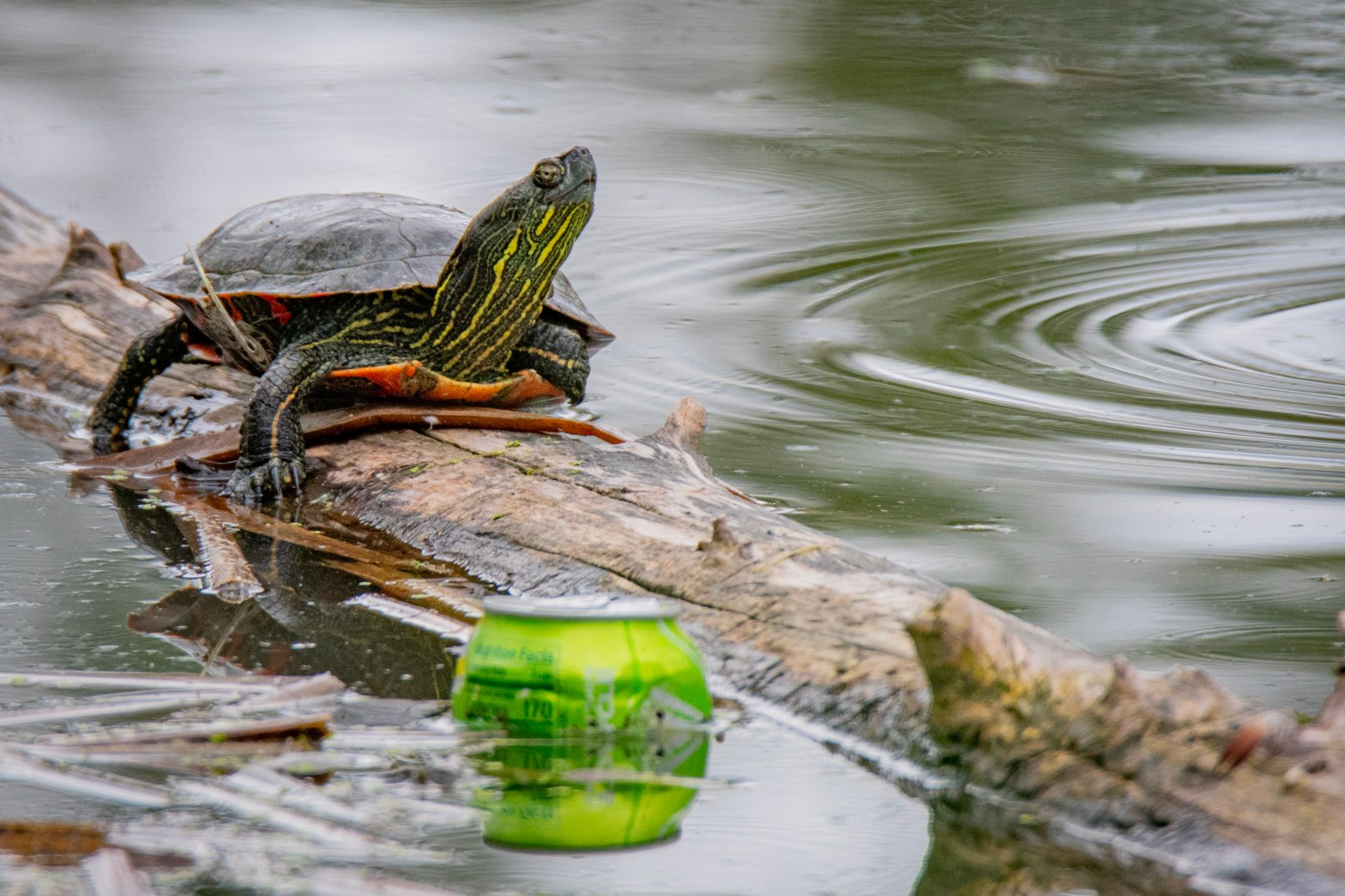
My dad, sister and I pull off Highway 200 and enter the Lubrecht Experimental Forest near Paws Up in western Montana. It’s just after 9 a.m. on a warm July day. Owned by the University of Montana, the 21,000 acre forest is used to practice new ways for managing Montana’s forests. Forestry is not the only kind of research currently being practiced at Lubrecht though, as we are on our way to join Erim Gómez, assistant professor of wildlife biology at UM. Erim is an ecologist, leader of the Charismatic Minifauna Lab, and an editor for the textbook: Introduction to Wildlife Management and Conservation in North America. Erim invited us to attach trackers to Painted Turtles, a species known by many Montanans and found in almost every lake and pond in the state.
Having been given only an OnX marker to navigate to, we spend the first 10 minutes getting lost along the winding, loopy roads of Lubrecht. We drive through cabins, trees, trees, cabins. More trees and cabins. I finally spot a thin wooden sign pointing to “Jones Pond”, and we drive off in the recommended direction. Almost immediately, we reach a metal green gate, which I open, fiddling with the lock and chain, then close (again, getting confused with the lock and chain).
Out my window, the limbs of Ponderosa Pines dapple the forest floor with light. Curving around the bend, a grassy field comes into view, sparsely populated with pines and with a patch of sagebrush growing in the southern corner. The grass merges into a massive pond, nearly the same size as the meadow. Some kind of aquatic reeds (perhaps cattails?) flourish along the bank, and algae blooms throughout the pond. When our olive green Subaru Outback pulls up alongside four other vehicles, an Evening Grosbeak takes flight, black and yellow wings pumping as it flies into a nearby juniper.
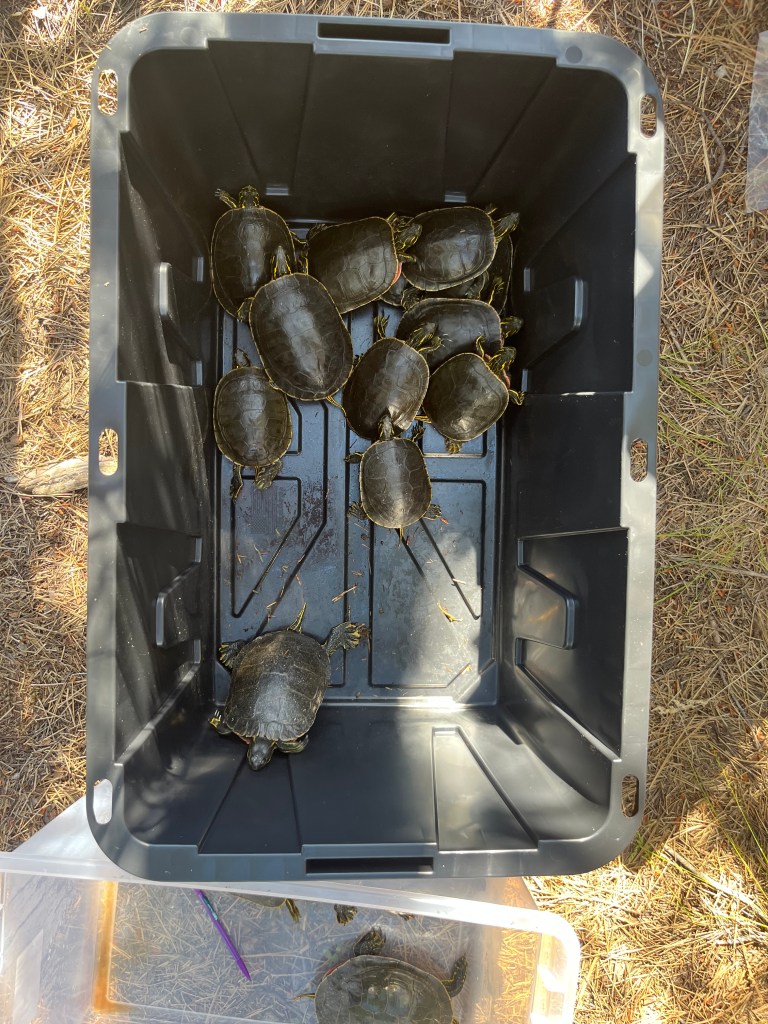
Ducking under branches drowned in lichen, we walk over to the research station: blue plastic tables, measuring tools, all in all not too different from what I have seen while bird banding, except for the methods of capture and the holding containers. A massive pile of mesh containers in the shape of a squat cylinder with holes for the turtles to enter through. Once the turtles entered, though, they would have a tricky time exiting, for the traps were designed similar to fish traps used on survival shows. A noise of scraping claws and shifting bodies draws my attention to a large black tote with a ‘bale’ of turtles jostling on top of each other.
Only four species of turtles breed in Montana, unlike the 32 found in Florida. The low diversity of turtles in the Treasure State is largely because of the weather. Few turtle species are adapted to withstand the winter temperatures capable of freezing most waters. To survive in this state the Painted Turtle has developed a sort of ‘antifreeze’ which prevents the chilly temperatures from freezing the cells in their bodies.
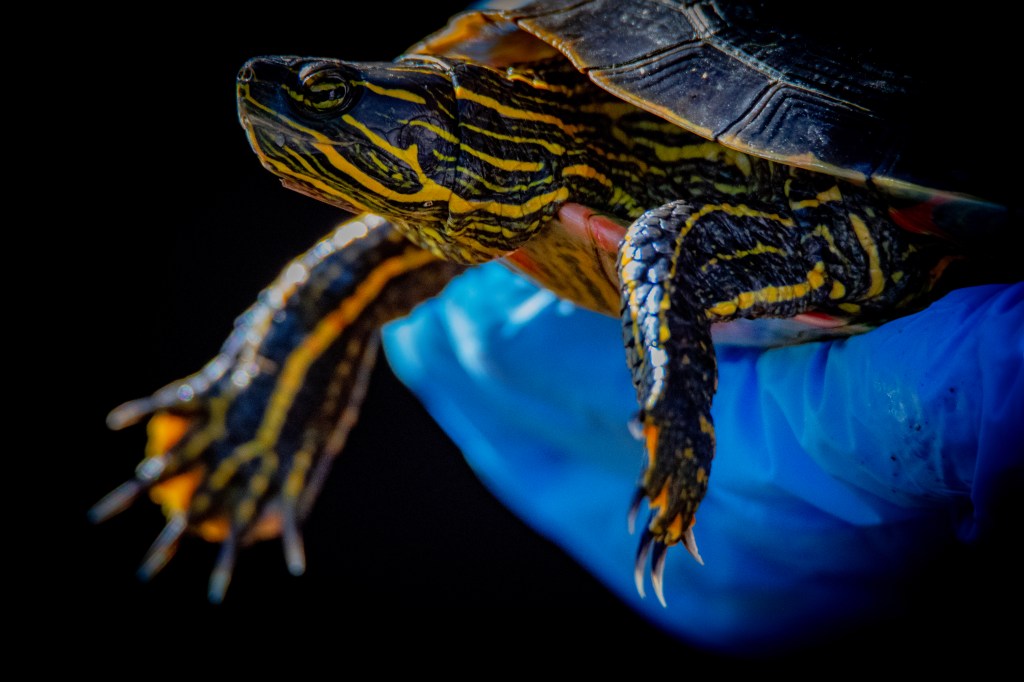
The size of a Painted Turtle depends on the subspecies (western, midland, or eastern) as well as the sex, with females being larger than males – a trait known as reverse sexual size dimorphism, which is also seen in many raptors. Montana is home to the western subspecies, which is distinguished by black and red markings on the lower shell. The average size of a Montana Painted Turtle ranges from 3-7 inches, with females hanging out on the upper end of the spectrum.
Back at Lubrecht, Erim hands out a box of plastic blue gloves, which my sister, Lucy, immediately puts on. Three wildlife biology students also don the flashy hand protection. An external flash for photography is positioned on the edge of the group and two photographers from UM are busy snapping pictures, asking questions and recording different parts of the process. A journalist stands nearby, taking notes. Erim picks up one of the turtles and points out the markings suggesting it is a female: relatively short claws and a lack of a vent beneath the carapace, which is just a fancy term for shell. The students then get to work measuring shells and sexing turtles, lifting up the tail and examining the claws (my! What sharp toenails you have!). The turtles are then placed into a plastic grocery bag and weighed. The students then hand them to Erim, who injects a tracker into the abdomen through a gap in the carapace. Looking resigned to being handled, the turtles droop their heads, but seem to regain all energy when placed into a white laundry basket. A few of the turtles are recaptures from two weeks ago, which are identified by the scar the needle left.
Slowly, the black tote empties of turtles, having been transferred to the laundry basket. Once the tote is nearly empty, one student picks up the basket and carries it down to the pond edge. I follow her, watching bluets and darners dash across the algae covered water. A family of geese meanders along the opposite bank before sliding into the water upon our approach. Killdeer call along the marsh edge. I realize what I originally thought were cattails are actually a grass called Foxtail Barley.
One of the photographers follows us down, carrying a massive underwater camera. The student carries the turtles one by one and sets them into the water with a gentle plop. A Columbia Spotted Frog squirms on the thick layer of algae as the reptiles go plunking into the hazy water. Laundry basket empty, we ascend the small hill and set the basket down. With only a few turtles left, Lucy and I follow a different student around the edge of the pond to collect more traps.
Five-foot tall bamboo poles are wedged into the muddy ground on the edge of the pond, with a pink piece of flagging plastic tied to the top. A roll of twine is held in place by the bottom of the pole, a portion of the twine extending taut into the water. Lucy begins to pull it and the corner of a mesh trap begins to come out of the murky water. A plastic Dasani water bottle bobs inside. “Turtles aren’t the only things finding their way in, and almost everything we manage to catch needs air.” The student explains when I ask her why such an odd object is in there. “An empty water bottle allows space for animals to breathe.” They leave the traps in for such a long time that most trapped animals would drown without enough oxygen. Two turtles are squirming about in the trap when we pull it out completely, accompanied by numerous water skippers and Kirby’s Backswimmers.
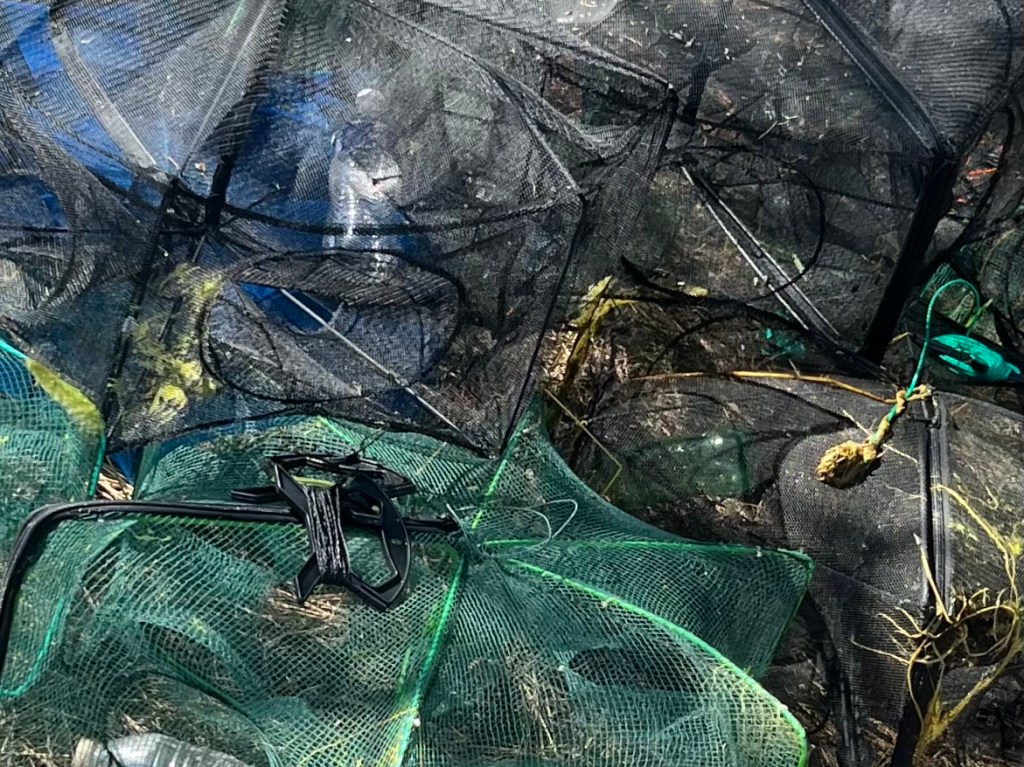
The next trap has sunk so low we miss it entirely, only finding it when I spot the pole jutting out of the muddy bank. Algae was caught on the zipper and weighed it down, opening it. A turtle that may have wandered in could quickly escape.
We have just pulled in the third trap when a yelp followed by laughter makes me jump. I turn around just in time to see a turtle falling from the sky. In a bid for freedom, it had wiggled back through an opening and leapt to the ground four feet below. It clatters over the rocks and attempts to slip back into the pond, but not before it is caught again and placed back inside the trap.
We carry the traps back to the shade of the ponderosas and unzip them, placing the turtles in the tote.
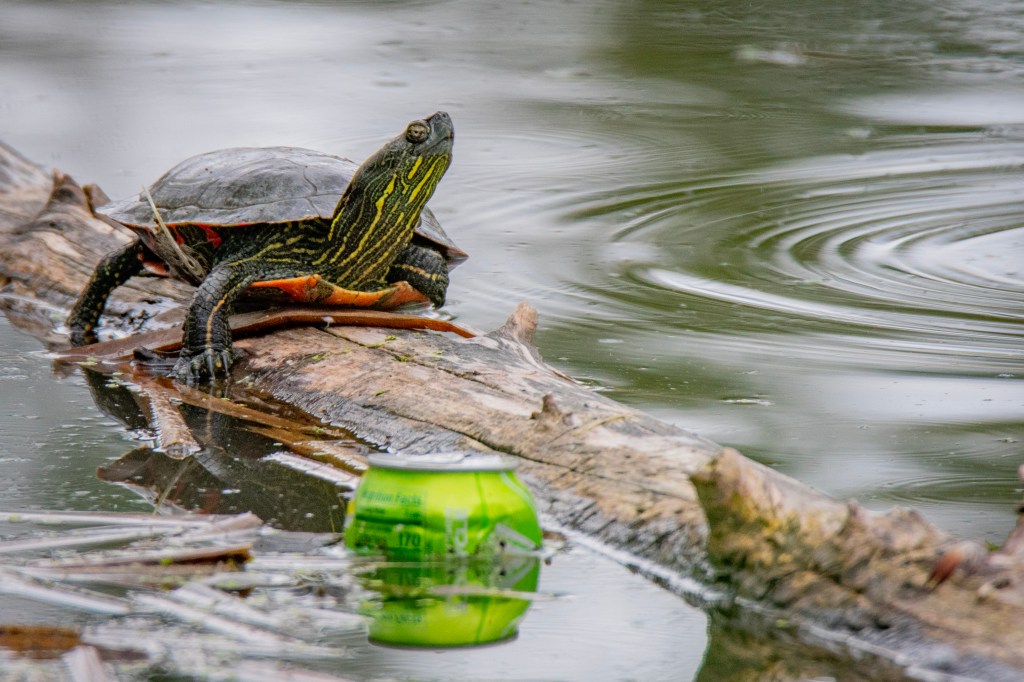
As lunch approaches and the sun climbs to a greater height over the Lubrecht Experimental Forest, my family and I pack up and climb into the Subaru. Erim and his students will continue this work until one, but there is work to be done at the house, so we won’t be staying through the entire afternoon. By the end of the project, Erim hopes to have an accurate estimate of the number of Painted Turtles in Jones Pond. When asked what his guess is right now, he says cheerily “Oh, about 200 or so.” Out in the middle of Jones’ Pond, a turtle head pops out of the water, beaked nose held high, watching the dust from the retreating Subaru rise in the afternoon air.
Additional Resources:


Excellent read by my amazing niece. I always learn something! Another Herring Family adventure!
LikeLike