PART TWO: INTO THE AIR
INTRODUCTION
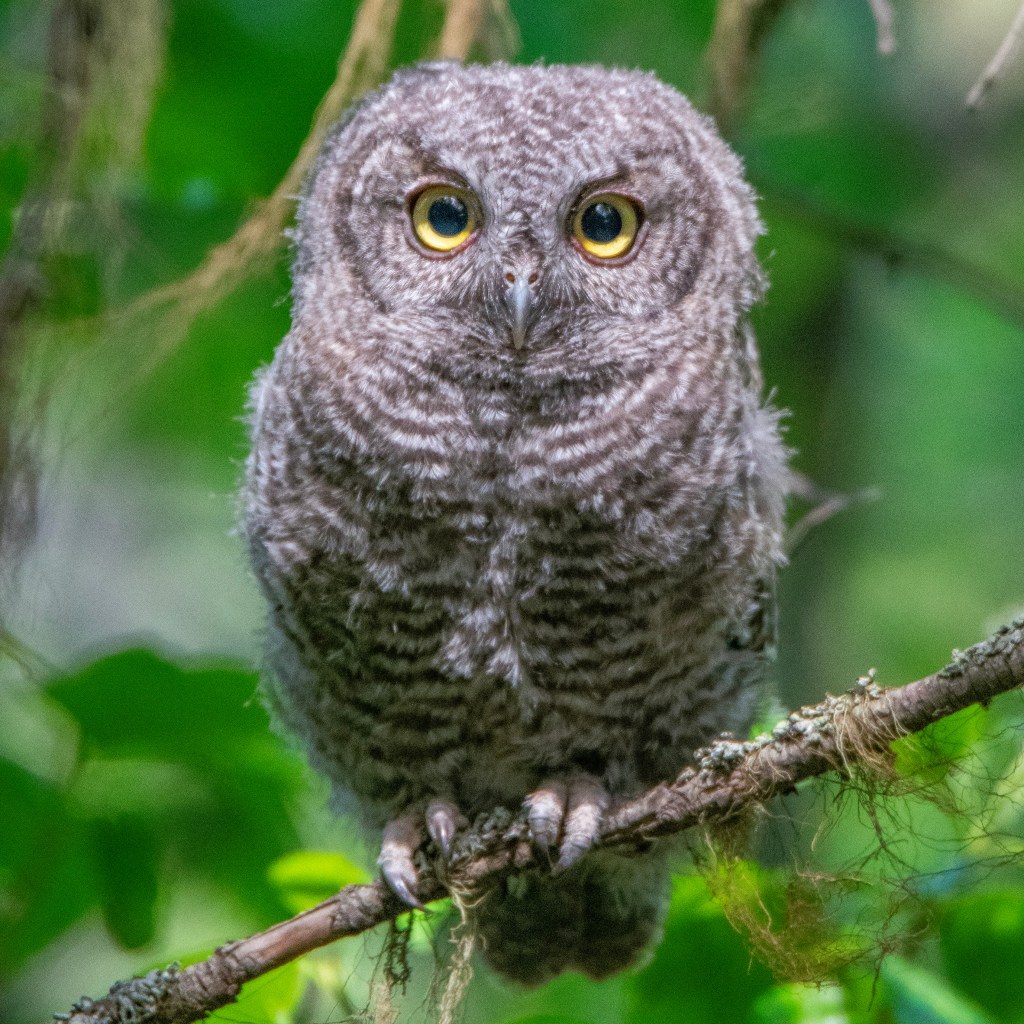
There are three stages to a young bird’s life, hatching, fledging, and dispersal. In the past five updates, I told the story of five hatchlings during the period of time when they were still dependent on their parents. Once a chick leaves the nest, it becomes a fledgling. Western Screech-Owls typically fledge four weeks after hatching. Fledglings are still dependent on the parents for food, but are beginning to learn how to be an owl. They still look very fluffy and cute, but will have developed more adult-like feathers. Another mark of a fledgling is the ability to fly. The last few days in the box are filled with wing flapping as the owlets build their flight muscles. Once they make the leap out of the box, the owlets will not return, instead roosting in nearby trees.
THE OWL IN THE OUTHOUSE
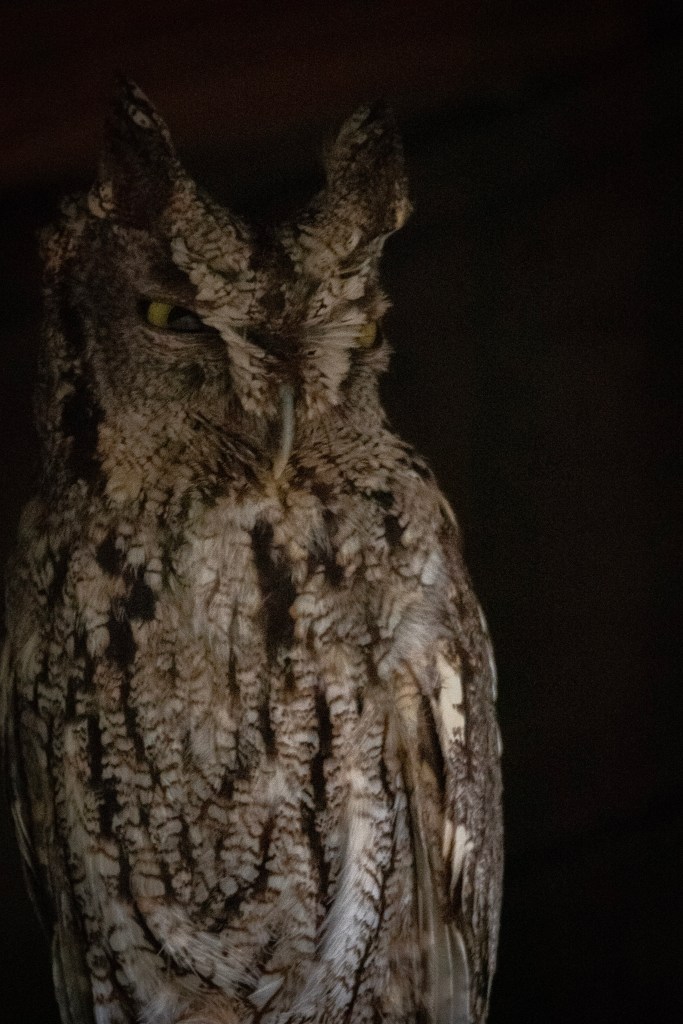
As we pull into the parking area on May 28th, barely a minute passes before Mom says “Hey, isn’t that the owl?” I immediately leap out of the car, camera in hand. “Where?” I ask, looking at the pine boughs above the truck, but not seeing anything. “Right there.” Mom replies, pointing to the owl perched underneath the roof of the outhouse, regarding us warily. Of all the places to roost, the owl chose the outhouse?! As we unpack, I keep an eye on the outhouse owl, watching it slowly swivel its head to track out movements. Eventually I take a walk by the river, watching dippers and warblers comb the banks for insects. Upon returning, I glance at the owls roost…and find the owl gone. For a second, I’m disappointed, but then Mom points it out (AGAIN), wedged up against the rafters. The owl continues to travel around the outhouse, occasionally coming out to watch us more carefully. After a few hours, I lose interest, waiting for the show tonight.
SNEAKY BABIES
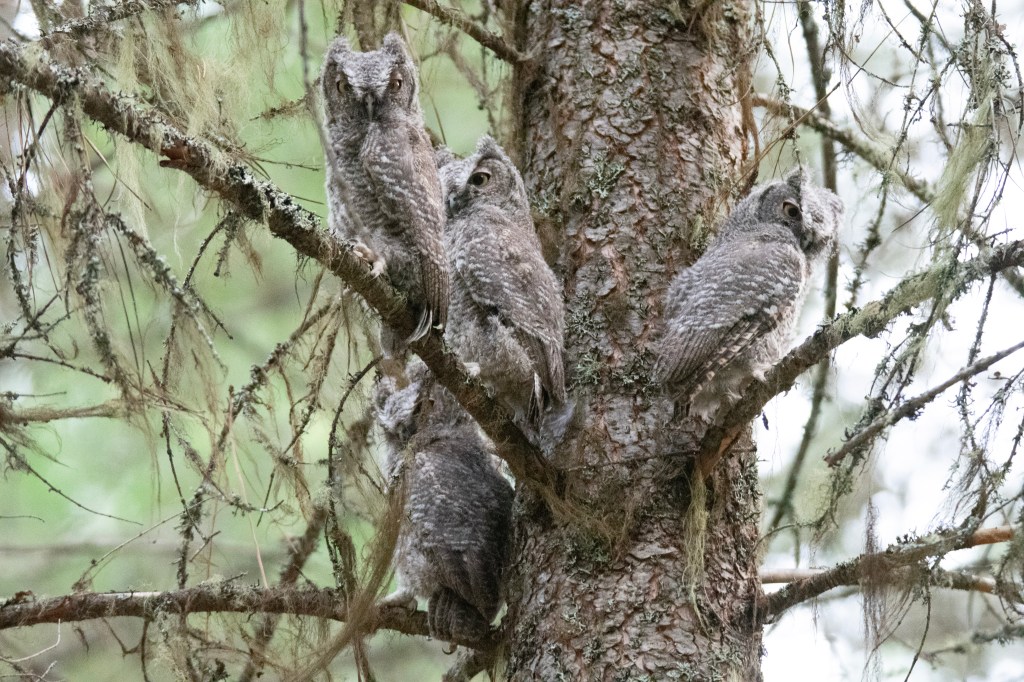
After seeing the owl in the outhouse, both Papa and I had searched the surrounding pines for the young owlets, with no luck. As dusk approached, I begin to worry, hoping all five owlets fledged and survived the week. I look over at the outhouse and find the owl gone, for real this time. Near the neighboring properties, a loud chittering noise intermixed with tremolos erupts from a thick Doug-fir. We walk over and see a fluffy gray shape barreling from tree to tree. Then another! And another! Five owlets flap around in the darkness, occasionally joined by an adult bringing in an insect. After watching them for a few minutes, another sound joins the chirps, hoots, and twitters of the evening. A slow, quiet hoo-hu-HOO-hoo-hoo. The hoot is enough to send the energetic owls into silence. Great-horned Owls are superpredators – predators that eat other predators. Western Screech-Owls are a quick meal, especially if they can barely fly. We head towards the sound, which grows nearer. Then, when we reach the grove of trees in which the Great-horned last called, the hoots rise up the talus slope and farther away.
May 29th
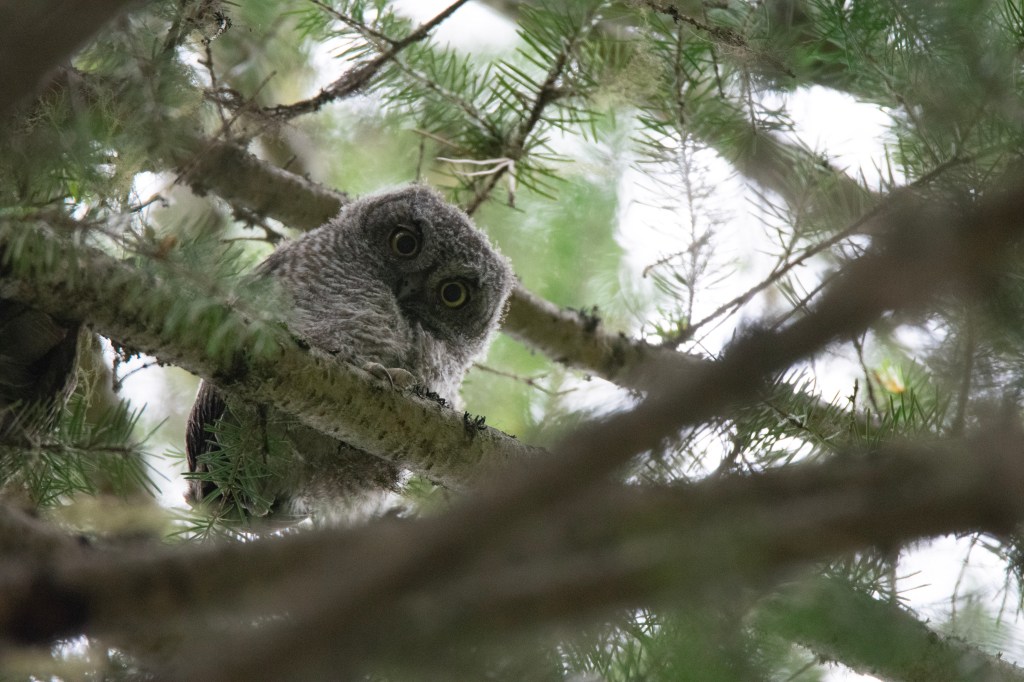
I rise late and head out to find the owlets. I look up as often as I look down, hoping to spot a pellet or splatter of whitewash. About halfway into the forest, I look up and see a fuzzy gray head peering around the tree at me. I run back down to the cabin, yelling as I do so: “I found the babies! I found the babies!” We head back up, gazing in wonder at their small, fluffy shapes. I turn around and see the yellow eyes of the adult gazing at us, ear tufts (plumicorns) sticking straight up.
Over the next few days, I am the first to find the owls in their sneaky hideaways. Usually, it goes like this: Me: I found them! Papa: Where?!” (I lead him over to the tree they are in.) Papa: I swear! I looked in that tree this morning!”
MISSING BABIES
On June 11th at 8:45 PM the forest is anything but quiet. Robins chirp in the canopy. Cicadas and crickets create a headache-inducing stream of chirps and trills. From a Douglas-Fir shadowed by pines, a young Western Screech-Owl chitters for food. A shadowy shape swoops in towards it and lands. An adult, it transfers an insect meal to the chick and disappears into the night.
June 12th
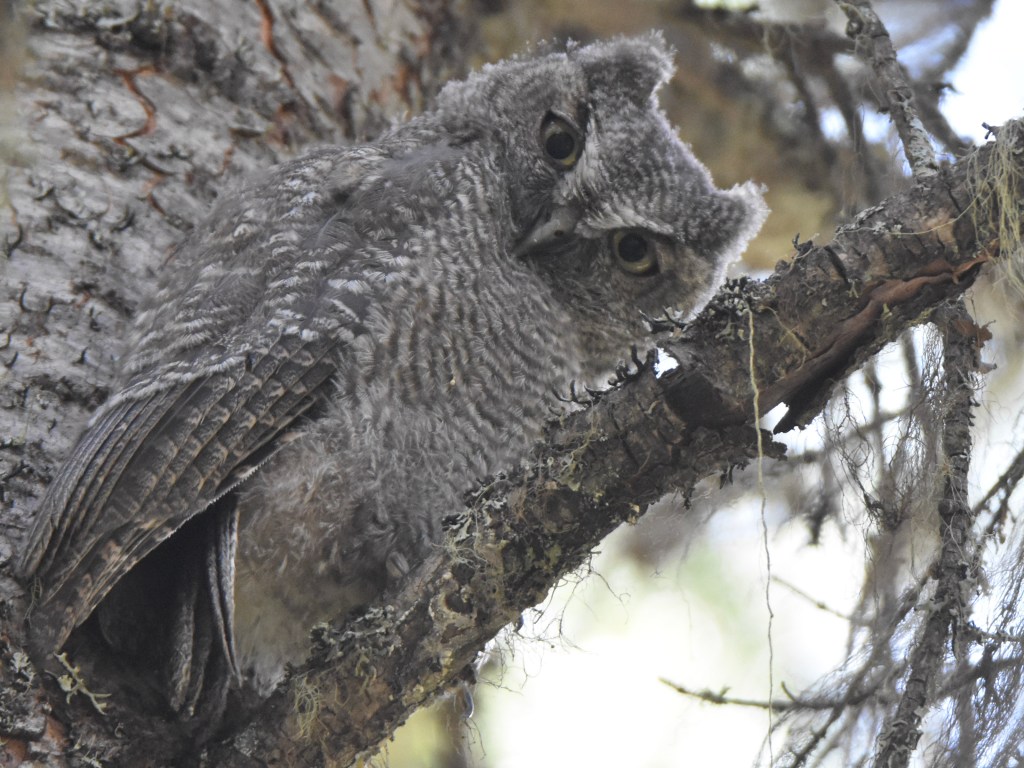
Rachael, Charlie, Avie, and Lydia are coming up Rock Creek for the first time since the night we saw the female hanging out of the nest box with a mouse. Not wanting to waste a minute, I lead them over to the stand the owlets have preferred and begin scanning the coniferous canopies. I spot the first owlet’s head, gazing curiously around a tree trunk. Another owl is perched up above it and a third sleeping a few trees over. As for the other two, they are nowhere to be found. Mom frets, while I try and explain to myself that there is no way two owlets can just vanish over night. Later that night, there is still no sign of the missing chicks or the mom. My mom comes in as I am brushing my teeth, exclaiming that she heard baby owls calling down by the river. Climbing into the back of Lydia’s Toyota for a sleepover, I listen for the soft tremolo of a screech-owl, but hear nothing through the open front windows.
June 13th
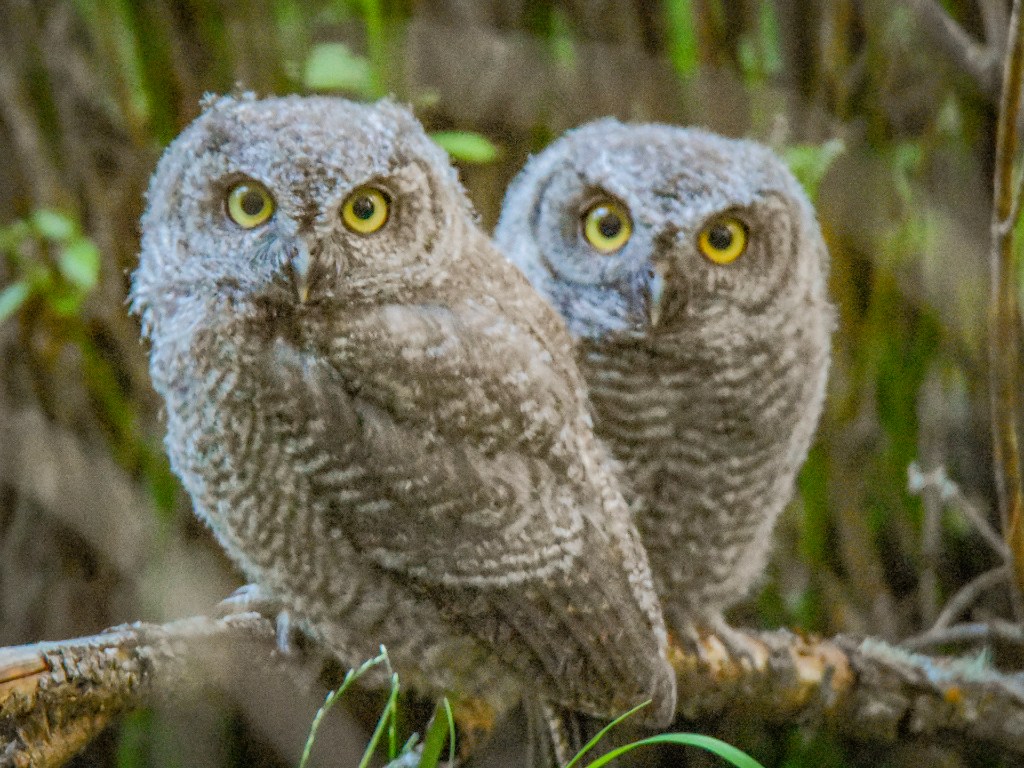
I would love to say I rose early in search of the missing babies…but I didn’t. When I finally found them, it was late in the evening. Lydia and her family had left in the morning and I spent the rest of the day wandering around and doing homeschool. I journeyed over to a stand of alders. A dark shape was huddled against one of the few conifers in the riverbottom. It was the first time we had found the female before the chicks. From behind me, Mom points on the ground where two chicks are perched on an overhanging branch. Another roosts off to the left. The chicks move around so fast it is nearly impossible to accurately count them. My best guess though, is that three still remain. We watch the activity until the last threads of sunlight have left the sky.
June 14th
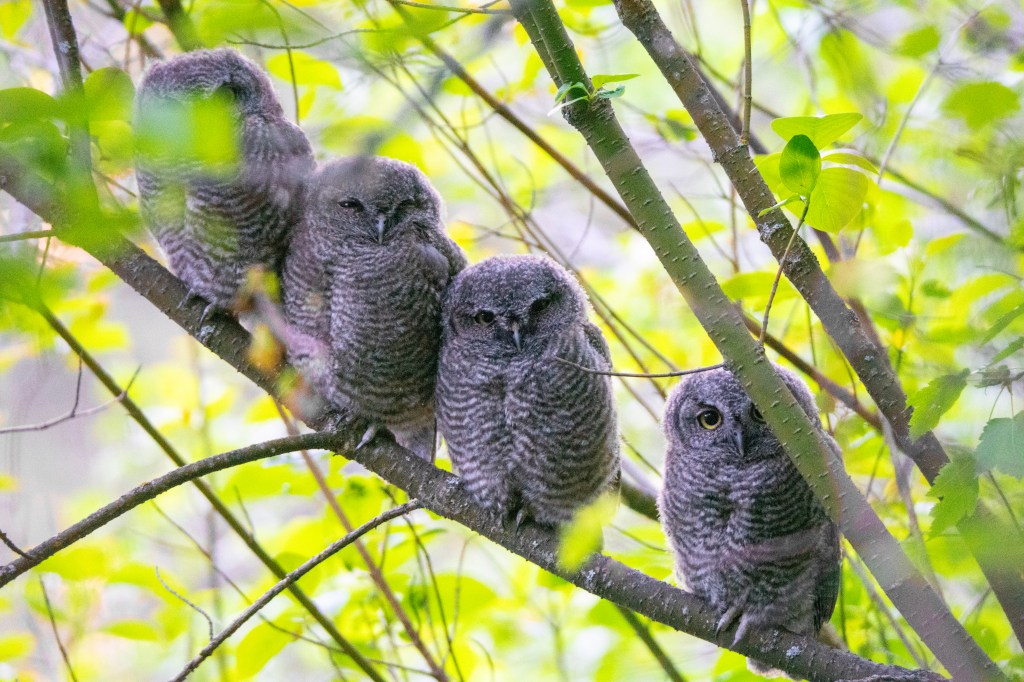
I find the female first, peering out from behind a looming Ponderosa Pine trunk. The male is with her, a couple trees away. The chittering owlets are easy to find. 1, 2, 3. Two are still missing. I run back to the cabin in search of my camera. When I come back, the chicks are hopping around. The male has left, presumably back to his roost. I sit down and watch the three chicks forage along the forest floor for goldenstones, a species of insect that spends the nymph stage of its life underwater before emerging as an adult in June. From out of a tangled mess of branches, two owlets fly over. They survived! I snap a picture of each of them, then run back to tell Mom (Papa is floating with friends). She comes over, but half the babies have vanished back into the undergrowth. Later that evening, when everyone has returned, I venture back to the grove of alders. On a branch overlooking the water sits four owlets, and the fifth is roosting in a snag nearby. Again, I run back to the cabin and exclaim excitedly “I found all five!”. As the sky dims, I watch them flutter around, with the female making occasional deliveries of food. One flies over to where I sit and regards me with curious yellow eyes before flying back to its family.
June 15th
All of the chicks have vanished and only the female remains in plain view. We are packing up, so I don’t have much time to investigate. I say goodbye and wish the owls good luck before clambering into the back seat and driving away.
– Dottie


oh
LikeLike
I was in so much suspense till the end of this story. So happy all five were found.
love to read about your experiences. Thank you.
love you lots.
LikeLike